NGO Working for Women Empowerment: How Siyaram Foundation Is Making It Real
Women empowerment starts when women get the right support, education, health awareness, and a fair chance to grow. Siyaram Foundation works to support women in underserved communities through education, healthcare, skill development, awareness programs, and livelihood-focused efforts.
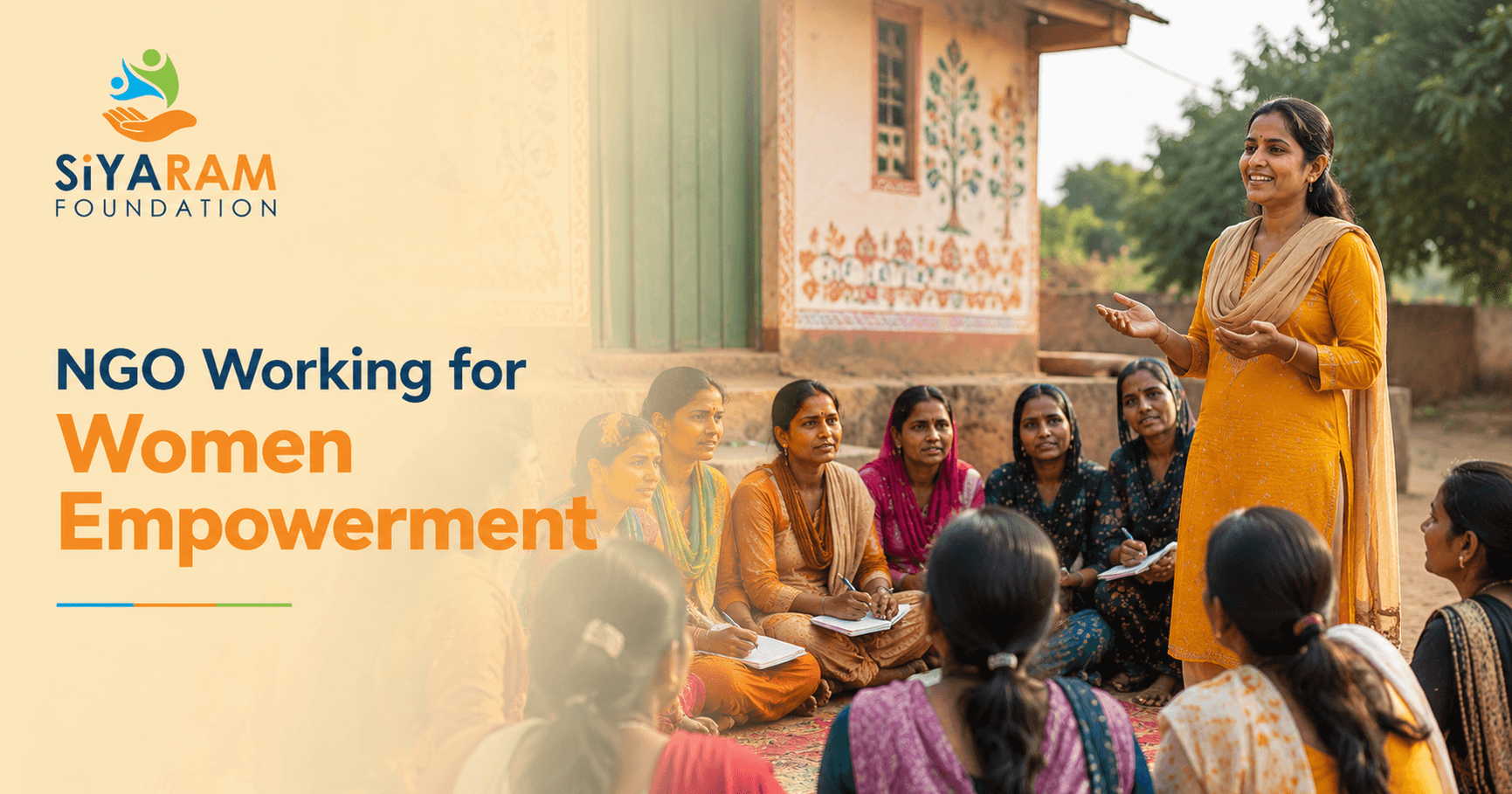
When Women Rise, Communities Rise With Them
Think about a woman you know, maybe in your own family. She's probably the one holding everything together. The house, the kids, the daily madness. Now think about what changes if she also has a skill, her own income, and the confidence to say what she thinks in a room full of people.
That's the real work of an NGO working for women empowerment. Not a one-day workshop. Not a certificate. It's about actually sitting with women, earning their trust, and staying until something in their life genuinely shifts.
Siyaram Foundation has been doing exactly that. This blog is about what that looks like on the ground.
What Does Women Empowerment Really Mean?
Everyone uses this phrase. Not everyone understands it.
Real empowerment doesn't look like a campaign poster. It looks like a woman finally opening her own bank account, after three visits, because she kept second-guessing whether she was even "allowed" to do it alone. It looks like a mother holding her ground, fighting to keep her daughter in school when the whole family has already started planning the wedding.
It looks like Geeta, a woman in her late thirties selling her homemade achaar outside her own street for the very first time. Small step. Huge shift.
Any women empowerment NGO worth its name understands this. The goal isn't good optics or impressive reports. It's real, lived, lasting change in how a woman moves through her own life.
What Women in India Are Still Dealing With
Let's be honest here, because softening things doesn't help anyone.
Women empowerment in India is a real and ongoing need not a slogan. Here's what the ground reality still looks like:
-
Girls in many parts of India still drop out of school once they hit puberty
-
Women doing the same farm work as men still earn less and almost never own land
-
Child marriage has reduced, but it hasn't gone away
-
Women are dying from health issues that are entirely preventable
And underneath all of that, there's something harder to see. The woman with a genuinely good business idea who won't say it out loud because nobody's ever told her that her ideas count.
That's the part that doesn't show up in news reports. But it's where the real problem lives.
How a Good NGO for Women Empowerment Actually Works
No one fixes deep-rooted problems in a year. The ngo for women empowerment that actually creates change is the one who comes in and listens first, for a long time before doing anything else.
They work with local leaders. They build trust slowly. They train women within the community itself, so that when the NGO eventually steps back, the knowledge and confidence stays.
Here's what meaningful women empowerment initiatives look like in practice:
-
Sitting with women's groups over months to build real trust
-
Training local women as health workers and legal resource persons
-
Creating space for women to say what they need, not what outsiders assume
-
Connecting women to government schemes they didn't know they had access to
There's no shortcut to trust. Anyone who tells you otherwise hasn't really done this work.
The Three Things That Hold Everything Together
Education
Keeping girls in school matters, but so does the 38-year-old woman who never got that chance. Adult literacy isn't a consolation prize. A woman who can read her own documents, understand a contract, and follow her child's school notices — that's a different kind of power.
Healthcare
Running one awareness camp a year isn't healthcare. Real access means solving the transport problem, the cost problem, and the deeply held belief many women carry that their health is the last thing worth spending money on.
Many women in underserved communities also face food insecurity, which directly affects health outcomes.
Women welfare programs in health need to cover reproductive health, mental wellness, and basic preventive care. That's not extra. That's the baseline.
Livelihood
When a woman earns money she controls, something changes at home. She has a voice at the table because she contributes to what's on it.
Skill training, microfinance, market access, when these are done right, they're not handouts. They're the first step toward real independence. And that changes everything downstream.
Rekha's Story: From Home Kitchen to Real Business
Rekha almost didn't show up to the first meeting.
She was 34, living in a small town in Uttar Pradesh. Her husband thought the women's group meeting was a waste of an afternoon. Her in-laws agreed. Rekha herself wasn't sure what a "meeting" would give her.
She'd been making pickles and papads at home for years. Neighbours would specifically request her stuff for weddings and festivals. She knew she was good at it. But her sales never went beyond the lane she lived in. She had no savings of her own and had never walked into a bank alone.
Over 18 months, things changed slowly.
She joined a self-help group. Did basic business training. Got a small loan to buy supplies in bulk and invest in proper packaging. Started selling through a women's collective with market connections she didn't have on her own.
By the end of the second year, she was paying her daughter's school fees herself. No asking. No explaining. No waiting.
"Paise se zyada, samajh aaya," she told a field worker. "I understood how things work now. That's what changed."
Her daughter is still in school. Rekha has started training two younger women in her neighbourhood. That part never fits in a progress chart, but it's exactly why women empowerment in India needs more people, more funding, and more honest attention.
What Siyaram Foundation Does Differently
A lot of organisations run good women welfare programs, but leave when the funding ends, and things quietly fall apart.
Siyaram Foundation's approach is different. Women here aren't treated as beneficiaries moving through a system. They're treated as people who know their own lives better than any programme coordinator ever will.
The foundation works across:
-
Literacy: for girls, women, and those who never got the chance earlier
-
Skill development: for women and adolescent girls, practical and market-linked
-
Health awareness: not just camps, but real access and education
-
Support for grassroots entrepreneurs: connecting women to markets, finance, and networks
As a women empowerment NGO, Siyaram Foundation builds local women as leaders within their own communities, so the work continues after the foundation steps back. The goal, genuinely, is to be less needed over time.
That's a rare thing to actually mean and even rarer to actually do.
Why Community Involvement Is Everything
Programmes designed without the people they're meant for tend to fail. Not always loudly. Sometimes they just quietly stop working after the money runs out.
Women in communities carry knowledge that no researcher picks up in a field visit. They know which family is genuinely struggling. They know which women empowerment initiatives will actually work and which will get quietly ignored. They know where the real resistance lives and it's rarely where outsiders assume.
When women are part of designing, running, and reviewing programmes, two things happen. The programmes get better. And the women get stronger because being taken seriously is itself a form of empowerment.
Final Thoughts
Nobody who's actually done this work will tell you there's a finish line. There isn't one.
Women's empowerment isn't something you wrap up and file away. It's years of showing up sometimes when nothing visible is happening, sometimes when things are quietly going backwards. It's unglamorous. It's slow. And it matters anyway.
The work continues because once you've seen what's possible, walking away stops being an option.
If you want to support an NGO working for women empowerment, skip the brochure. Ask how long they've actually been in the same communities. Ask what the women they worked with five years ago are doing today. Ask whether local women are leading the work, or just showing up for it.
Those questions will tell you everything the website won't.
Women empowerment in India doesn't need more noise. It needs more people willing to back the quiet, long-haul work, the kind that doesn't trend but actually changes lives. A good ngo for women empowerment like Siyaram Foundation is proof that this work is possible.
Slowly. Stubbornly. For real.
FAQs
1. What does an NGO working for women empowerment actually do?
Honestly, it's hard to put in one line. Some days it's running a literacy class. Some days it's just sitting with a group of women over chai, talking, and slowly building enough trust that they feel safe saying what they actually need. Beyond that self-help groups, skill training, helping women access government schemes they didn't even know existed. It looks different every single day, and that's honestly what makes it real work.
2. How can I support women empowerment initiatives in India?
If you can give money, give regularly, even a small amount every month is more useful than a big one-time donation. NGOs can actually plan around consistent income. But money isn't the only way. If you work in law, medicine, finance, or even communications, a lot of grassroots organisations desperately need that kind of help and can't afford to hire for it. And honestly? Just talking about this work, sharing it with people who might care that matters more than most people think.
3. Why does women's empowerment matter for everyone, not just women?
Because it doesn't stay contained. When a woman starts earning her own income, her kids are more likely to stay in school. When she understands her health rights, the whole family's wellbeing shifts. Field workers see this play out again and again it's not a theory. Women reinvest in their families and communities in ways that quietly ripple outward. So no, it's not a separate "women's issue." It sits right in the middle of how any community actually grows.
4. What makes Siyaram Foundation different from other women welfare programs?
A lot of organisations do good work but quietly fall apart once the funding cycle ends. What's different here is the focus on building local women as leaders within their own communities health workers, legal resource persons, group facilitators so the knowledge doesn't leave when the foundation steps back. The goal is genuinely to be less needed over time. Not many organisations actually mean that. Siyaram Foundation does.
5. Can a small donation really make a difference?
More than people realise. A lot of this work runs on surprisingly thin budgets. A small recurring donation, even ₹300 or ₹500 a month can cover a woman's skill training for the whole month. The size matters less than the reliability. Unpredictable funding is one of the biggest reasons good programmes stall. If you can commit to even a small amount every month, that consistency is genuinely valuable.