Best Charitable Organizations in India : 2026 Guide
Charitable organizations in India play a vital role in improving lives through education, healthcare, food support, and community development programs. Siyaram Foundation is committed to creating sustainable social impact by helping underprivileged communities across India.
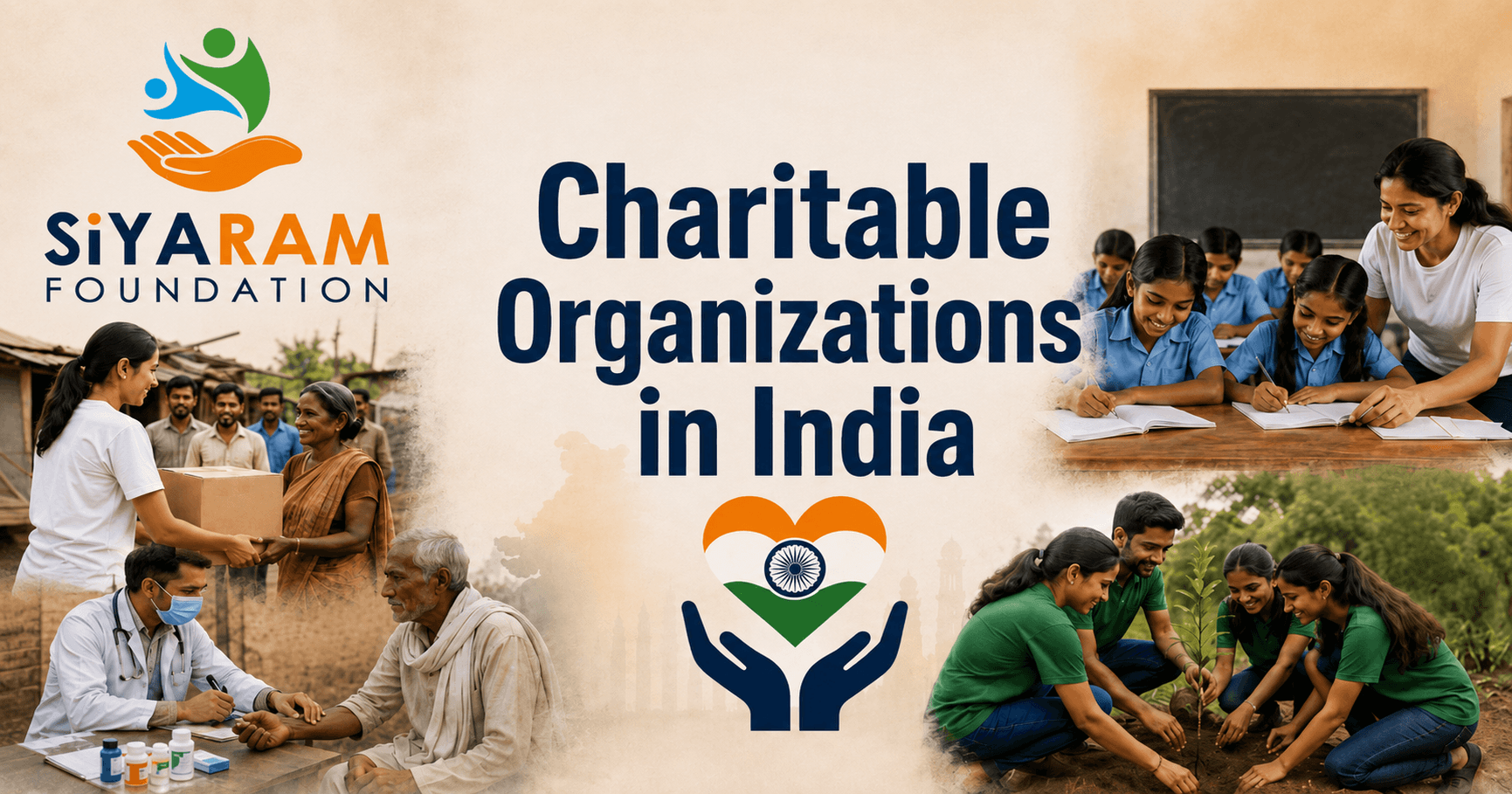
There's a girl named Priya. Nine years old, from a village in Uttar Pradesh. Two years ago, she had never held a pencil.
Not because she wasn't sharp. Not because her family didn't care. But in her home like in thousands of others a girl going to school just wasn't something that happened. Her mother never went. Her grandmother never went. Nobody questioned it. That was just life.
Then one afternoon, someone knocked on their door. No banners. No official event. Just a volunteer, a school bag, and one simple promise I'll come back next week.
Priya is in Class 4 now. She reads. She writes. And her mother will not let her younger daughter miss a single day.
This is what charitable organizations in India look like when the work is genuine. No press releases. Just people showing up, again and again, for communities the system hasn't consistently reached yet.
The ASER 2023 report found that only 43.3% of Class 5 students in rural India can read a Class 2 level text. NITI Aayog's Aspirational Districts data shows that in over 100 of India's most underserved districts, health and education infrastructure still falls critically short. These are the exact communities where Siyaram Foundation shows up and does work that actually matters.
The Evolving Landscape of Philanthropy and Social Sectors in India
India's growth story is real. Among the world's largest economies. Cities expanding. Talent recognized globally.
But drive a few hours outside any of those cities and the picture shifts. Children who have never sat in a classroom. Families managing serious illness at home because the nearest clinic is too far. Elderly men and women waiting in villages their children left years ago. Women told, quietly and constantly, that ambition isn't really for them.
Government programs exist some do genuine good. But the distance between a policy decision and a village in Chhattisgarh is enormous, and a lot falls through that gap. Charitable organizations in India live in that gap not as a temporary fix, but as a permanent ground-level presence in communities the system hasn't figured out how to reach.
Siyaram Foundation is one of those organizations. What sets it apart isn't the number of names on a beneficiary list. It's how much actually shifts in real families, in real communities because of the work it does.
Evaluating Trust: What Defines Effective Charity Frameworks?
Let's be honest a lot of charity work looks better from the outside than it actually is.
A group arrives, sets up a one-day camp, distributes supplies, clicks photos, and drives back to the city. The community feels noticed for 48 hours. A week later, nothing has changed.
The Best Charity Foundation in India refuses to work like that. Real work starts with listening understanding what a community actually needs, not deciding from a conference room what's good for them. It means building trust slowly and staying long after the launch excitement fades.
Siyaram Foundation is fully compliant with 80G registration, 12A tax exemption certification, and files clear financial transparency statements all publicly accessible. Every program is built from real conversations with the communities it serves. Slower. Less flashy. But the only kind of work that holds up five years later.
Beyond School Enrollment: How We Measure Success in Child Education
Here's something worth saying plainly getting a child into school and actually educating them are two very different things.
Millions of children across India are enrolled. On paper, the numbers look decent. But walk into a classroom in rural Bihar or eastern Rajasthan and you'll often find one teacher managing three grades at once, no electricity, no functional toilets. Girls quietly stop attending once they hit a certain age. Boys get pulled into daily wage work because that money is real and it's needed now.
An NGO for Child Education that only tracks how many kids got enrolled is honestly not tracking the right thing.
India's Right to Education Act guarantees free schooling for every child and that's an important step. But a legal guarantee doesn't fix a crumbling classroom or convince a worried mother that keeping her daughter in school is worth it. Local Anganwadis do valuable early childhood work, yet in many districts the gap between what children learn there and what Class 1 actually expects of them remains far too wide.
This is exactly the gap Siyaram Foundation works in. Not just getting children through the door but making sure they stay, actually learn something, and don't quietly slip away before anyone notices. It works directly with mothers, because in most households she's the one whose opinion actually decides whether a daughter keeps going to school. It assigns mentors who check in with individual children every single week, not classroom averages, actual kids. It builds learning spaces across Uttar Pradesh, Bihar, and Rajasthan where children feel genuinely comfortable showing up.
Getting Priya enrolled was step one. Making sure she's still there in Class 8, with real skills and real choices ahead of her that's what a genuine education NGO in India is actually built to do.
Bridging the Rural Medical Gap: Delivering Essential Healthcare to Villages
Think about the last time you needed to see a doctor. You probably just looked one up, booked something, and went. It wasn't a big decision.
For a large part of rural India, that's not even close to the reality.
In hundreds of villages across Rajasthan, Bihar, Jharkhand, and Odisha the nearest health center is 30 or 40 kilometers away. And even when one exists on the map, the doctor might show up twice a month. The medicines ran out months ago and haven't been replaced. A woman goes into labor at 2 AM and there's no vehicle, no signal, and no one to call.
So the family waits. They try whatever is available at home. They hope it passes.
Sometimes it does. Sometimes it costs them everything.
The National Health Mission and Gram Panchayats were built to solve exactly this. And in some areas they genuinely have. But across India's most remote blocks, what exists in government records and what actually shows up in a village are still two very different things. This is the space where Healthcare NGOs in India do work that quietly matters every single day.
Siyaram Foundation isn't trying to replace the public health system. It's trying to make sure basic care actually reaches the people who need it in the village where they live, in a language they understand, delivered by someone their community already knows. Mobile health camps bring check-ups and diagnostics directly to remote areas. Maternal and child health programs start well before delivery, not after something goes wrong. Immunization drives cover the blocks where government reach is still thin. And local women are trained as community health workers because someone from the same village will always be trusted more than an outsider passing through once.
The focus is always prevention. Catching high blood pressure before it becomes a stroke. Spotting malnutrition in a pregnant woman before it reaches her baby. The best work healthcare NGOs in India do never shows up in headlines it's the emergencies that never happened, the crises that were quietly stopped before they ever started.
The Crisis Nobody Talks About : India's Senior Citizens
By 2050, over 300 million Indians will be above 60. A lot of them are already living alone,not by choice, but because life moved on around them. Sons went to cities. Daughters married far away. The joint family that once held everything together has quietly come apart over the last two decades.
What's left is an old man in a house that used to be full, managing his illness by himself, going full days without a real conversation. The physical difficulty is real. The nutritional gap is real too many elderly people eat once a day because cooking alone is tiring and money runs short. But the hardest part, honestly, is the loneliness. That particular feeling of the world simply continuing without noticing you're still in it.
Siyaram Foundation works on elder care across three layers, making sure no one skips meals, running regular health check-ups that catch problems early, and building community spaces where older adults come together and feel like they still belong somewhere.
One 70-year-old told a Siyaram Foundation volunteer: "I used to just wait for the day to end. Now I have somewhere to be."
That is not a small thing. That is the whole point.
Hunger, Women, Environment : It's All Connected
India produces enough food to feed itself many times over, yet families eat one meal a day, not because food doesn't exist, but because the money ran out. A hungry child can't focus in class. A man skips medication he can't take without food. Hunger bleeds into education, health, and dignity. This is why Siyaram Foundation threads nutrition through every program it runs. Food donation NGOs doing serious work in India understand this connection, and Siyaram Foundation is built around it.
And none of it works in isolation. When a woman earns her own income, her children stay in school longer. When girls see real options, generational patterns crack. Environmental NGOs in India and NGOs working for women's empowerment are doing work entire communities depend on and Siyaram Foundation weaves it all together, because real change never comes from fixing just one thing.
Siyaram Foundation : Impact at a Glance
|
Sector |
Core Ground-Level Challenge |
Siyaram Foundation Initiative |
|
Child Education |
56.7% of rural Class 5 students struggle with Class 2 text (ASER) |
Specialized learning spaces, mother engagement programs, and weekly mentorship in UP, Bihar, and Rajasthan |
|
Rural Healthcare |
Missing medical infrastructure and severe delays in emergency care |
Mobile health camps, preventive screening, and training local women as community health workers |
|
Elder Care |
Isolated seniors facing deep nutrition gaps and chronic illness |
Three-layer support: nutrition tracking, medical monitoring, and community spaces |
FAQs
1. What do charitable organizations in India actually do?
Honestly, they do the work that falls through the cracks. Government schemes exist but they don't always reach the last village, the oldest widow, or the child who dropped out in Class 3. That's where these organizations step in working on child education, healthcare, nutrition, elder care, and community support in places that are simply not on anyone's priority list.
2. How is Siyaram Foundation different from other NGOs?
Most organizations come in, run a program, and move on. Siyaram Foundation doesn't work like that. It stays. It comes back next week and the week after. Instead of solving one problem at a time, it looks at the whole picture because a hungry child can't learn, a sick mother can't work, and an isolated elderly person needs more than just medicine. Everything is connected, and so is the work.
3. What makes the Best Charity Foundation in India worth trusting?
Ask the hard questions first. Is it registered? Are its financials publicly available? Are real people in real communities actually better off not just for a week after a camp, but a year later? Siyaram Foundation is registered under 80G and 12A certifications and maintains clear financial transparency so donors always know exactly where their money is going.
4. How does an NGO for Child Education go beyond just enrollment?
Getting a child enrolled is honestly the easy part. The harder work is making sure she doesn't quietly disappear from the register by Class 5. A genuine NGO for Child Education works with parents, assigns mentors, does regular follow-ups, and builds an environment where the child actually wants to come back tomorrow not just on day one.
5. What kind of healthcare services do NGOs in India provide?
Think about everything a rural family simply can't access on their own a doctor, vaccines, prenatal care, basic medicines. Healthcare NGOs in India bring all of this directly into communities through mobile health camps, maternal and child care programs, immunization drives, trained local health workers, and regular health awareness sessions. Quiet work. But it saves lives every single day.
6. How does Siyaram Foundation help senior citizens?
It starts with the basics making sure elderly people aren't skipping meals or missing medications. Then come regular health check-ups. But Siyaram Foundation understands that an old person with no one to talk to is suffering too, just differently. So nutrition support, medical care, and community programs all run together, because dignity means taking care of the whole person, not just the physical part.
7. Is it safe to donate to an NGO in India?
Yes as long as you do a basic check first. Look for proper registration, audited financials, and 80G certification. Siyaram Foundation holds 12A and 80G certifications and maintains complete financial transparency every rupee is accounted for and you can see exactly how it's being used.
8. Can I volunteer even if I'm not a doctor or teacher?
Absolutely. You don't need a medical degree or a teaching certificate to make a real difference. Siyaram Foundation needs people who can write, fundraise, communicate, support events, do community outreach, or simply show up consistently. More often than not, commitment and genuine care matter far more than any professional qualification.
Conclusion
Real change in India rarely looks like a big moment. It looks like a volunteer making their third visit to the same family. A girl who stayed in school when everything around her said she should leave. An old man who has somewhere to be on a Tuesday morning.
Charitable organizations in India are building that change one community, one family, one person at a time. Siyaram Foundation is part of that story. And you can be too.
Donate. Volunteer. Show up.
Visit Siyaram Foundation today and be part of the change.