Education for Underprivileged Children in India: Building a Brighter Tomorrow
Every child deserves access to quality education, regardless of their background or financial situation. At Siyaram Foundation, we work to support underprivileged children through educational assistance, learning support programs, and community outreach initiatives. By investing in education today, we help create a brighter, more empowered future for the next generation.
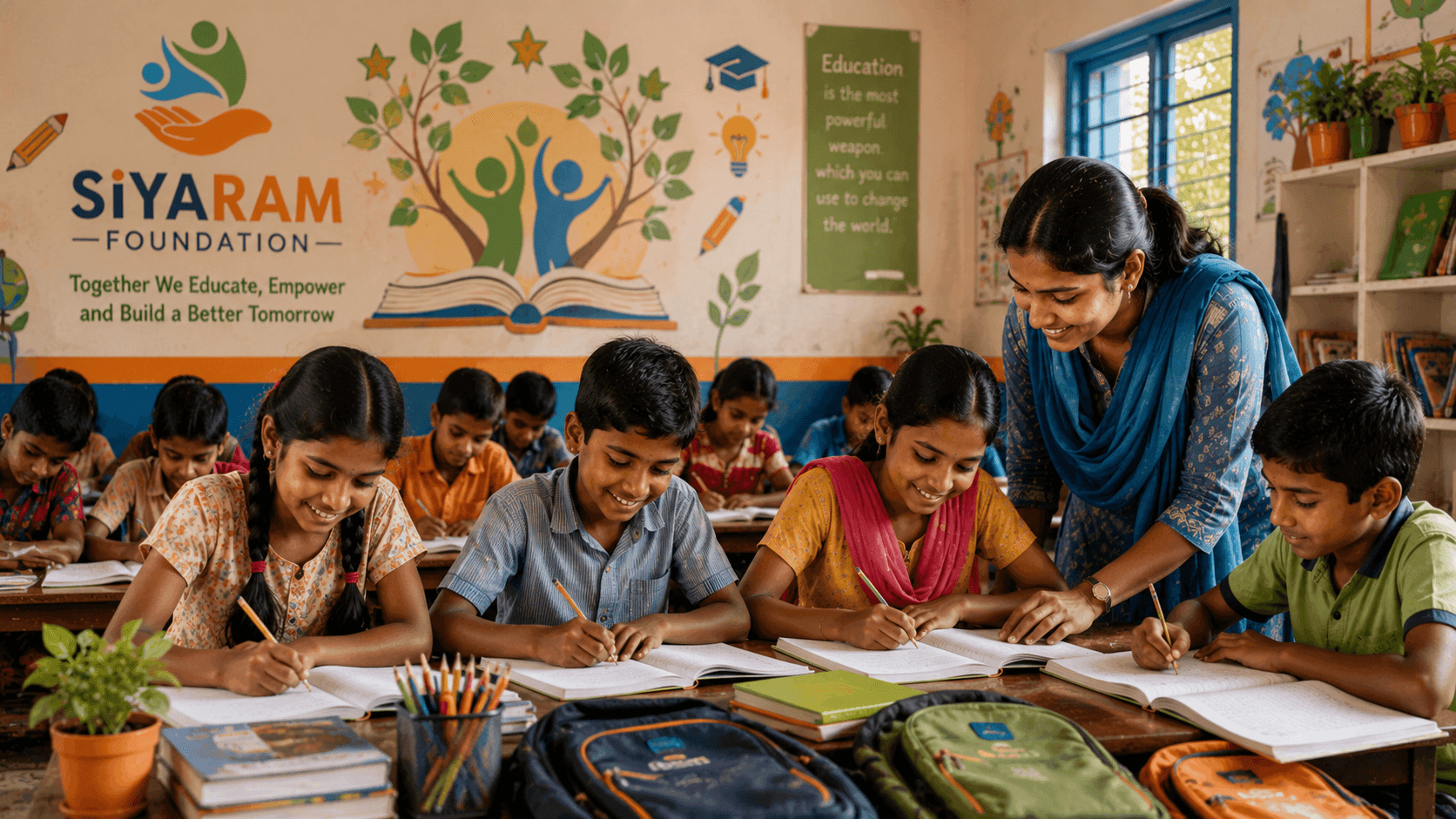
Walk into almost any Indian town and you'll spot it a child who ought to be in school instead standing behind a shop counter, or crouched next to their mother at a roadside vegetable stall, or minding a younger sibling so both parents can go out and work. These children aren't lacking in curiosity or intelligence; if anything, most have plenty of both. What's missing is simply the chance. Education for underprivileged children in India continues to be one of our most persistent social challenges, and traces of it can be found in nearly every corner of the country.
This piece tries to unpack why that matters so much, what stands in the way, and how organisations like Siyaram Foundation are working to change things a child at a time, a classroom at a time.
Why This Issue Matters
For a child born into poverty, education is hardly ever just about marks or passing exams. More than anything, it's the one factor that decides whether they end up living out the same struggles their parents did, or actually get a chance to write a different story.
Consider what changes once a child genuinely learns to read and write. Suddenly, they stand a much better chance of landing steady work down the line, of understanding rights they'd otherwise never even hear about, of making better calls around health and family life, and eventually of handing their own kids a stronger starting point than what they had. Now multiply that by the millions of underprivileged children in India who still don't have dependable access to proper schooling, and the sheer weight of what's at stake becomes hard to ignore.
There's a simpler way to put all of this too. A child's right to learn has nothing to do with which pin code they were born in or how much their father earns. That's not a bonus anyone's asking for it's the bare minimum every child deserves.
Major Challenges
Rarely does just one thing keep an underprivileged child out of school. Usually, it's several problems piling up together until a family feels backed into a corner with no real choice left.
-
Money troubles at home: Government schools may not charge fees, but the costs around them uniforms, books, bags, getting there and back still add up to more than plenty of households can manage.
-
Child labour: For many families, especially those running small farms or shops, a child's daily earnings feel far more real than a promise of something better years down the line.
-
How far away school is: In rural or remote areas, the nearest school could be several kilometres out, with no dependable or safe way to reach it, something that ends up affecting girls the most.
-
Schools that aren't equipped: Crowded classrooms, no working toilets, no clean water to drink, and too few trained teachers can wear down whatever motivation brought a child there in the first place.
-
Bias built into the system: Girls, children with disabilities, and kids from marginalised backgrounds often run into extra resistance, sometimes from their own families and sometimes from a system that just doesn't notice them.
-
The first-generation gap: When a parent never went to school themselves, they're often left without the means to help with homework or push for something better when things aren't working for their child.
These issues rarely show up on their own, which is exactly why solving even one of them usually isn't enough.
Impact on Children and Communities
The fallout from missed schooling doesn't stop with the child it spreads outward.
Kids who never enrol, or who leave school early, become far easier targets for exploitation. Early marriage, unsafe labour, trafficking all of these become more likely once a child has no classroom to structure their day around and no teacher or mentor watching out for them.
The wider community pays a price too. Places with lower literacy tend to see worse outcomes from Healthcare NGOs in India working in the same areas, along with weaker participation in local decision-making, and slower economic movement overall. People who've never had access to education are, understandably, less equipped to push for better roads, hospitals, or governance in their area and that gap just keeps feeding itself.
But flip the situation around, and the story changes completely. One child who stays in school and does well can be the reason an entire household starts taking education seriously for the younger ones too. A girl who completes her schooling typically marries later, has healthier kids of her own, and earns independently. This isn't a hopeful theory ,it's a pattern that keeps repeating in communities where educational support has actually stuck around long enough to make a difference.
How NGOs Are Making a Difference
Programmes like the Right to Education Act and mid-day meal schemes have made a real difference over time, but they haven't closed every gap, particularly for children who exist at the fringes of the system, the ones easiest to miss entirely. Educating underprivileged children the right way takes more than policy on paper; it takes people on the ground, and that's the space where a dedicated Education NGO in India tends to step in.
Much of what these organisations do isn't flashy at all. It's going house to house tracking down kids who've quietly stopped attending school, spending time with anxious parents to figure out what's holding them back, sorting out transport or catch-up classes for children who've lost pace, and picking up the small costs a struggling household just can't cover on its own.
Still, walking a child through the school gate doesn't mean the job is done. It counts for little if there's no trained teacher waiting inside, or if the place doesn't feel safe enough to stay in. That's the reason behind after-school tuition centres, digital learning setups, and vocational training that many NGOs run for older kids who've already missed their usual chance at formal schooling.
Equally important is everything that has nothing to do with a syllabus. A child who's gone hungry can't really pay attention in class. One who's facing neglect at home isn't thinking about multiplication tables. The NGOs that get this right have figured out something basic their job is the whole child, not just what shows up on a report card.
Practical Solutions and Community Support
No single fix solves this problem on its own. What actually works is a mix of interventions, each one covering a gap the others can't.
-
Sponsorship and scholarship support that covers fees, books, and uniforms for children whose families simply cannot stretch that far.
-
Community awareness efforts that help parents see the long-term value of keeping a child especially a daughter in school, rather than pulling her out at the first sign of financial strain.
-
Bridge and remedial classes for children who've already missed years of schooling, offering a way back in without making them feel behind or out of place.
-
Mid-day meals and nutrition support, since hunger remains one of the quietest but strongest barriers to learning.
-
Digital learning tools that are increasingly helping bridge gaps in areas where trained teachers are hard to find.
-
Vocational and life-skills training that gives older teenagers something practical to hold onto alongside their academics.
On their own, none of these do very much. Put together money, trust, food, and decent teaching they start to actually change how a child's future unfolds.
How Siyaram Foundation Contributes
For Siyaram Foundation, education for underprivileged children in India isn't a side initiative it's the core of what we do, day in and day out. We step directly into low-income communities, find the children who've dropped out or are on the edge of doing so, and stick around with these families instead of offering a one-off donation and disappearing.
On the ground, this means paying for basics like uniforms, books, and stationery for households that just can't afford them, holding extra learning sessions for kids who've slipped behind in their studies, and spending real time with parents and communities to build genuine faith in what schooling can do for their children. In some areas where the nearest school for underprivileged children is simply too far or too unsafe to reach, we also work to arrange transport so distance stops being the reason a child misses class. We keep a close eye on girls' education in particular, since they're almost always the first to be taken out of school the moment a family runs short on money.
For us, the work isn't over once a child's name shows up in a school register. It continues in whether they keep turning up, how they're progressing, and eventually, whether they enter adulthood with actual choices ahead of them instead of none at all. Every child in our programmes is a reminder of why we do this and every small victory, be it a girl completing tenth grade or a boy who once worked at a shop counter now doing well in maths class, is exactly what pushes us forward.
Conclusion
There's no shortcut to fixing education for underprivileged children in India, and no single scheme, donor, or organisation is going to solve it alone. But something does shift when communities, NGOs, and families start pulling in the same direction a child stays in school instead of stepping into a job too early, and that alone counts as real progress toward a more equal country.
Call-to-Action
You can be part of that shift. Whether it's a one-time donation, sponsoring a child's education every month, or just talking about the cause with people around you, it helps Siyaram Foundation reach more children who are simply waiting for a chance. As an underprivileged children's charity working closely with communities on the ground, we make sure your support reaches the families who need it most. Visit our website and see where your support could make a difference.
FAQs
1. Why is education important for underprivileged children in India?
It's often the deciding factor in whether a child repeats the struggles their parents faced or gets a real shot at something better better work, better health decisions, and more independence down the line.
2. What are the biggest challenges in educating underprivileged children in India?
Money troubles, child labour, schools that are too far away, poor infrastructure, gender bias, and parents who never had schooling themselves to lean on usually all at once, not one at a time.
3. How do NGOs help underprivileged children access education?
By finding out-of-school children directly, offering scholarships or supplies, running catch-up classes, providing nutrition support, and staying close to the families involved instead of stepping away after one visit.
4. How does Siyaram Foundation support these children's learning?
We cover essential school costs, run learning support for children who've fallen behind, and stay engaged with families long-term with a particular focus on keeping girls in school.
5. How can I help support this cause in India?
Through donations, monthly sponsorships, volunteering your time, or even just talking about the issue. Every bit adds up for organisations trying to reach more children.