When Nobody Comes Home: Why Every City Needs an NGO for Old Age
Siyaram Foundation is committed to supporting elderly individuals through community care, social engagement, healthcare awareness, and assistance with government welfare schemes. Our goal is to help senior citizens live with dignity, independence, and emotional well-being.
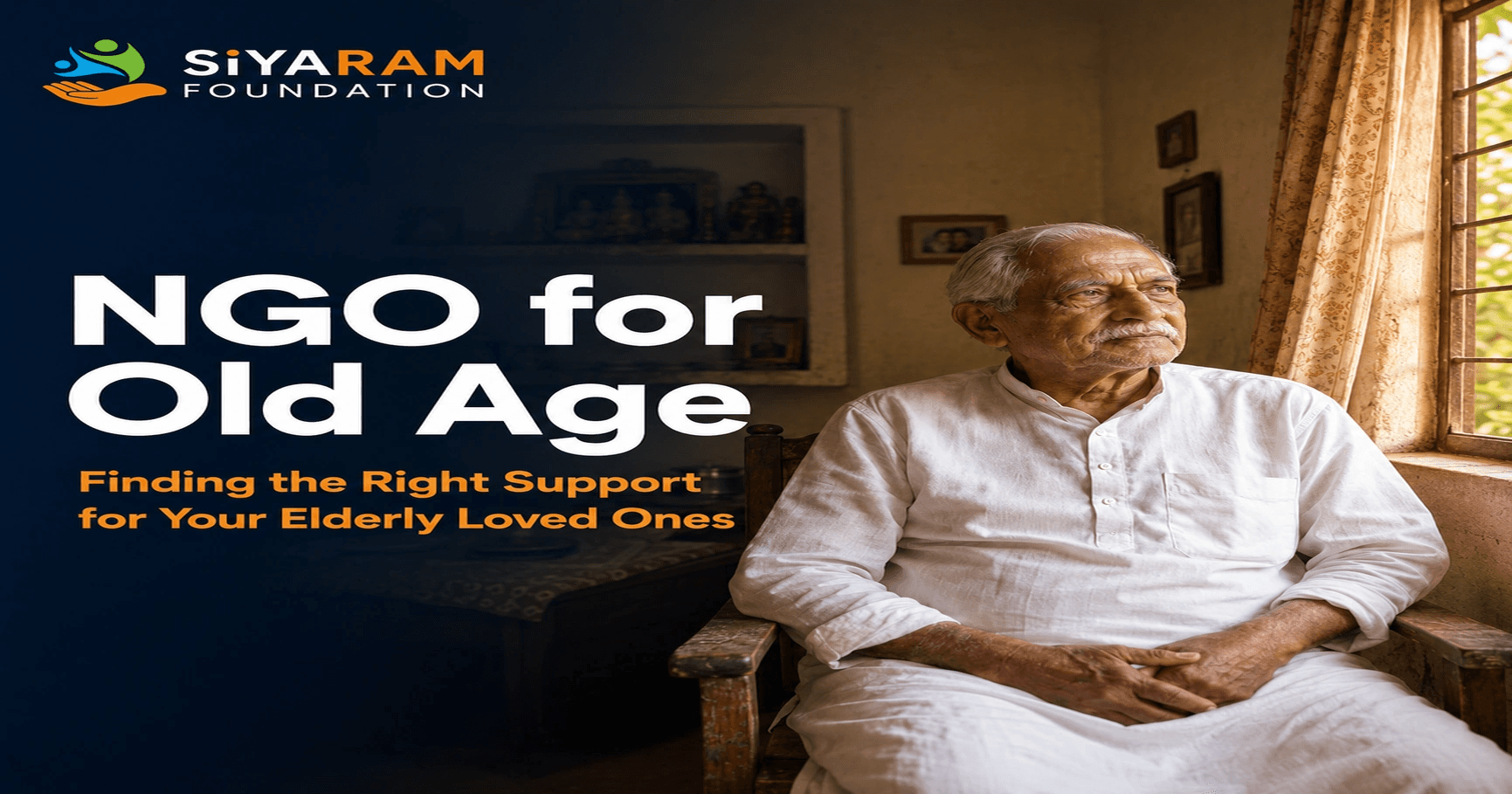
There's a kind of quiet that comes after the children leave. Not peaceful. Just... empty.
Dinner at 5 pm for no reason. Clock ticking too loud. Phone on the table — you're not waiting for a call exactly, but you keep checking anyway.
Suresh Prasad, 76, knew that feeling. Wife gone since 2020. Son in Bengaluru — good man, calls on Sundays when he remembers. The flat in Varanasi where Suresh ji spent forty-three years stopped feeling like home somewhere along the way. More like a place he was just... present in.
He quit going to the market. Blamed his knees, which wasn't entirely a lie. His neighbour Sharda had been quietly watching this for months. Said something to her daughter. Her daughter knew someone at a local NGO for old age. A few weeks later, Suresh ji was in a room with eleven other retired men, loudly disagreeing about whether Jadeja should open the batting.
Why Elderly People in India Need More Support Than Ever
Something shifted in Indian families over the last thirty years, and it happened slowly enough that nobody really planned for it.
The old model, three generations under one roof, elders respected as the centre of household decision-making started fraying. It didn't disappear overnight. It crumbled at the edges first. A son who moved to a different city for a job. A daughter-in-law who worked. A grandson who grew up not really knowing how to talk to his dada for more than fifteen minutes. Normal life. Modern life.
But for the elderly person left behind, the change can feel like freefall.
India has over 140 million people above the age of 60 right now. That number is climbing every year, and the support systems built for a different erajoint families, neighbourhood communities, local religious institutions, are not keeping pace. Government schemes exist but are massively underused. Private care is unaffordable for most. And the gap between what elderly people need and what they actually receive has never been wider.
It's not that families have stopped caring. Most haven't. It's that caring from 800 kilometres away has real limits.
The Weight of Loneliness
Here is something that doesn't get said enough: loneliness kills. Not metaphorically. Clinically. Research has shown links between chronic loneliness and everything from heart disease to dementia to premature death. And yet when we talk about the problems elderly people face in India, we tend to jump straight to healthcare costs and pension amounts. The emotional dimension gets treated like a softer, secondary issue.
It isn't.
Spend time with the volunteers at any ngo for old age people and you'll hear some version of the same observation again and again, that the physical health of an isolated elderly person tends to deteriorate in ways that don't fully make sense until you understand how alone they are. They stop eating properly because cooking for one feels pointless. They stop sleeping well because the nights are too long. They start skipping medications because what's the urgency, really.
A 68-year-old retired schoolteacher in Allahabad once told a volunteer: "I taught children for thirty-five years. Now I go two, three days sometimes without speaking to a single person." She said it without self-pity, which somehow made it worse.
Social connection isn't a nice-to-have for elderly people. It's a basic health requirement. And the organisations that understand this are the ones doing the most effective work.
Healthcare That Quietly Slips Out of Reach
Most people don't think about what retirement means for healthcare until it happens to them or to their parents.
For those who worked in the formal sector, there's sometimes a pension and a health insurance policy of some kind. But for the vast majority of India's elderly, the ones who ran small shops, worked as tailors, swept offices, did daily wage work for decades there is no employer to fall back on. They're navigating the public health system alone, which is its own kind of obstacle course.
The forms. The queues. The hospital that's a two-hour bus ride away. The specialist appointment that takes six weeks to get. The prescription that costs ₹800 a month when the pension is ₹1,400.
Elderly women face this particularly sharply. Widowed, often without independent income, sometimes with no one to accompany them to a hospital they will tolerate pain and symptoms for months before seeking help. By the time they do, what was manageable has become serious.
NGOs working in elderly care step into these gaps in ways the formal healthcare system simply cannot. Volunteers accompany people to hospitals. Health camps come to the neighbourhood instead of asking elderly residents to travel. Someone sits with the paperwork and explains what the form is asking.
(Many healthcare NGOs in India are expanding this kind of last-mile support, recognising that access and awareness are often bigger barriers than the absence of medical infrastructure.)
Financial Insecurity After a Lifetime of Work
Ask someone what they're most afraid of in old age and most won't say death. They'll say dependence.
The idea of not being able to pay for your own medicines. Of having to ask your son for money at 72 when you spent thirty years making sure he never had to ask you. Of not knowing if the ₹3,000 in your account will last until the end of the month.
This is the reality for a significant portion of India's elderly. Particularly those from unorganised labour backgrounds domestic workers, street vendors, construction workers, small farmers, who spent their working lives earning just enough to get by, with nothing left over to save. Retirement for them isn't a planned phase of life. It's just the moment when the body stopped cooperating.
The psychological damage of financial insecurity in old age is not separate from the physical health impact it's the same thing. Chronic stress, sleeplessness, skipped meals, avoided medical appointments. It all connects.
Siyaram Foundation works with elderly people not just by providing services but by connecting them with entitlements they didn't know they had government pension schemes, health cards, subsidised ration access. The goal isn't to make people feel taken care of. It's to give them back a sense of control over their own lives.
Dignity Is Not Optional
This one matters more than it might seem.
When you spend time around elderly people in India, in the villages, in the old parts of cities, in lower-middle-class housing societies, you notice something. You notice how often they are spoken over. How their opinions get dismissed mid-sentence. How well-meaning younger family members make decisions for them without asking what they want. How "What do you know about smartphones?" becomes a small, daily sting.
Elderly people notice all of this. They just often don't say anything because they've learned that saying something creates conflict, and at 70-something, you don't want to be the cause of family tension.
One of the things that makes Siyaram Foundation's work stand out is the insistence that dignity is not a program component it's the whole point. The way a volunteer knocks on a door matters. The way a health camp is set up, so that people sit in chairs rather than squatting on the floor, matters. The way a community gathering is framed, not as charity for the needy but as a gathering of experienced people who deserve each other's company, that framing matters enormously.
Small things. But they add up to the difference between elderly people who feel seen and those who feel shelved.
Savitri Devi Didn't Need Saving. She Needed Company
Savitri Devi turned 68 last March. She's been a widow since 2019. No children. She rents a single room near a railway colony in Lucknow, manages on a widow's pension, and occasionally gets some money from a relative in Kanpur who feels guilty but can't do more.
When Siyaram Foundation volunteers came to her neighbourhood as part of an outreach drive, Savitri Devi had not left her room in four days. Not because she was sick. Because there was nowhere to go and no reason to go there.
She was cautious at first about the weekly women's gathering. Showed up late the first time. Sat near the door. But there was a woman there who made the same kind of achar her mother used to make, and somehow they ended up in a forty-minute conversation about food preservation techniques, and Savitri Devi forgot to be guarded.
She's been going every week since.
Her blood sugar, which was dangerously high when volunteers first arranged a health check-up, has come down substantially partly through medication but mostly, the volunteers will tell you, because she's eating properly again. Because someone checks in. Because there are people she'd feel embarrassed to let down.
Today, Savitri Devi volunteers herself when a new woman joins the group who looks the way she once did sitting near the door, watching, not quite trusting. She goes and sits beside them. She doesn't say much at first. Just sits.
How NGOs Are Filling a Critical Gap
The government has several programs for elderly citizens old age pensions, health schemes, senior citizen homes. On paper, the framework exists. The problem is the distance between what's written in policy documents and what actually reaches an elderly person sitting alone in a two-room house in a small town.
Awareness is low. The documentation requirements are often impossible for people who have never kept records. The offices where applications are processed are frequently far away, understaffed, and not set up to handle people who struggle with stairs or long waits.
The most vulnerable elderly people, the ones who need government support the most are almost always the least able to navigate the system to get it.
This is where a good ngo for old age near me becomes genuinely invaluable. Siyaram Foundation's ground-level work means volunteers are present in the same neighbourhoods, the same lanes, where elderly people actually live. They know who needs help. They're not waiting to be found they're going door to door.
(The Foundation's work extends beyond elderly care. They collaborate with education NGOs in India, support food donation NGO initiatives, and work alongside environmental NGOs in India because community wellbeing is never just one problem with one solution.)
What Siyaram Foundation Actually Does, Day to Day
It's easy to describe NGO work in grand terms dignified ageing, holistic wellbeing, community empowerment. Those words aren't wrong, but they don't quite capture what the work looks like on a Tuesday afternoon.
It looks like a volunteer sitting with a 79-year-old man going through his medicines, making a simple chart in Hindi that tells him which pill to take when. It looks like a health camp set up under a neem tree in a colony where the nearest clinic is four kilometres away. It looks like someone making eight phone calls to sort out a pension that lapsed three years ago because a form got lost.
Siyaram Foundation runs regular community gatherings for senior citizens, not as an event, but as a consistent weekly presence that people can rely on. They conduct health monitoring camps with basic screenings and follow-up referrals. They help elderly people enrol in government schemes they're entitled to. They train volunteers, often young people from the same communities, to visit elderly individuals living alone, not for inspections, but for conversation.
For families trying to figure out support for an ageing parent from a distance, Siyaram Foundation can also be that trusted local presence. Someone who knows the person, knows the neighbourhood, knows what's actually happening.
If you've been searching for the best NGO near me with real, ground-level elderly care work this is that kind of organisation.
What the Community Can Do That No NGO Can
NGO volunteers can visit once a week. Maybe twice. They can organise health camps quarterly. They can be on the other end of a helpline.
But a neighbour is there every day.
The thing about elderly people living alone is that the crises are rarely dramatic. It's not usually a fall or a medical emergency that does the most damage it's the slow accumulation of days where nothing happens and no one comes. The weeks of eating biscuits for dinner because cooking felt like too much effort. The gradual retreat from every activity until the radius of a person's world is just that one room.
A neighbour who notices. A local tea shop owner who saves a chair. A building watchman who checks in if he hasn't seen the aunty in 2B for a couple of days. These things are not small. They are the tissue that holds the community together between every visit from an NGO volunteer.
India's elderly people spent their whole lives building things for others families, institutions, neighbourhoods. The question now is whether those neighbourhoods will hold them in return.
Frequently Asked Questions
1. What does an NGO for old age typically do?
The work varies by organisation, but most cover a combination of health support, social programs, and help accessing government schemes. Some run residential homes; others like Siyaram Foundation, focus on community-based care that keeps elderly people connected to the neighbourhoods they've lived in for decades. It's less about institution and more about presence.
2. How can I find a reliable NGO for old age near me?
Online searches help, but local connections often work better. Ask at community centres, religious institutions, or neighbourhood associations. Siyaram Foundation has a presence across multiple cities and can direct you to programs operating near your area.
3. How do NGOs support elderly people who live alone?
Regular home visits, telephone check-ins, community gatherings, and health monitoring are the main tools. Siyaram Foundation's volunteers are specifically trained to build genuine relationships with isolated elderly people not just to tick a welfare check box, but to be someone that person is actually glad to see.
4. Are these services free for elderly beneficiaries?
Siyaram Foundation's core services are provided at no cost to elderly people. Programs are funded through donations, CSR partnerships, and in some cases government collaboration. Nobody is turned away because they can't pay.
5. How can I get involved either as a volunteer or donor?
You can contact Siyaram Foundation through their website. Volunteer roles range from regular home visits to helping at health camps to assisting with paperwork and government scheme enrolment. Even an hour or two a week makes a meaningful difference.
6. What signs suggest an elderly person in my neighbourhood might need support?
Watch for things like not stepping outside for several days, visible weight loss over a short period, confusion about their medications, a generally unkempt appearance when that wasn't true before, or just a general withdrawal from the small routines they used to have. If something seems off, trust that instinct. Reaching out to an NGO for old age people costs nothing and could mean a great deal.
The House Got Quiet. It Doesn't Have to Stay That Way.
Suresh ji still misses his wife. He always will. And his son being in Bengaluru is just the reality of how families work now.
But on Thursdays, he puts on his kurta and walks twenty minutes to sit in a room with eleven other retired men. He argues about cricket. He drinks tea that someone else made. He is, for a few hours, not the man waiting alone in a flat, he's just one of the regulars.
That didn't happen by accident. It happened because someone set up a program. Because a volunteer knocked on a door. Because an NGO for old age understood that belonging is not a luxury.
The infrastructure for dignified ageing in India is still being built. Siyaram Foundation is part of that construction. So are the neighbours who pay attention, the families who stay connected, and the volunteers often young people, often with no particular training except the willingness to show up who make the whole thing real.
Be Part of This With Siyaram Foundation
If you know an elderly person who is slipping into isolation or if you are that person Siyaram Foundation is worth reaching out to. Contact the Foundation to find programs near you, to volunteer, or to support the work financially.
And if you can do nothing else right now, check in on the elderly person in your building, your lane, your family. Ask them how they've actually been. Sit for a while.
It costs nothing. It means everything.
Get in touch with Siyaram Foundation through their website or speak to their team about how to get involved.
Beyond elderly care, Siyaram Foundation works in women empowerment, education, food security, healthcare access, and environment because real change in a community happens on every front at once.