Right to Education: Why Every Child in India Deserves Equal Learning Opportunities
A child's future shouldn't depend on their parents' income or where they were born. Learn how India's Right to Education Act 2009 and Article 21A guarantee free schooling for every child aged 6–14 — and how Siyaram Foundation helps turn that promise into reality for underserved communities.
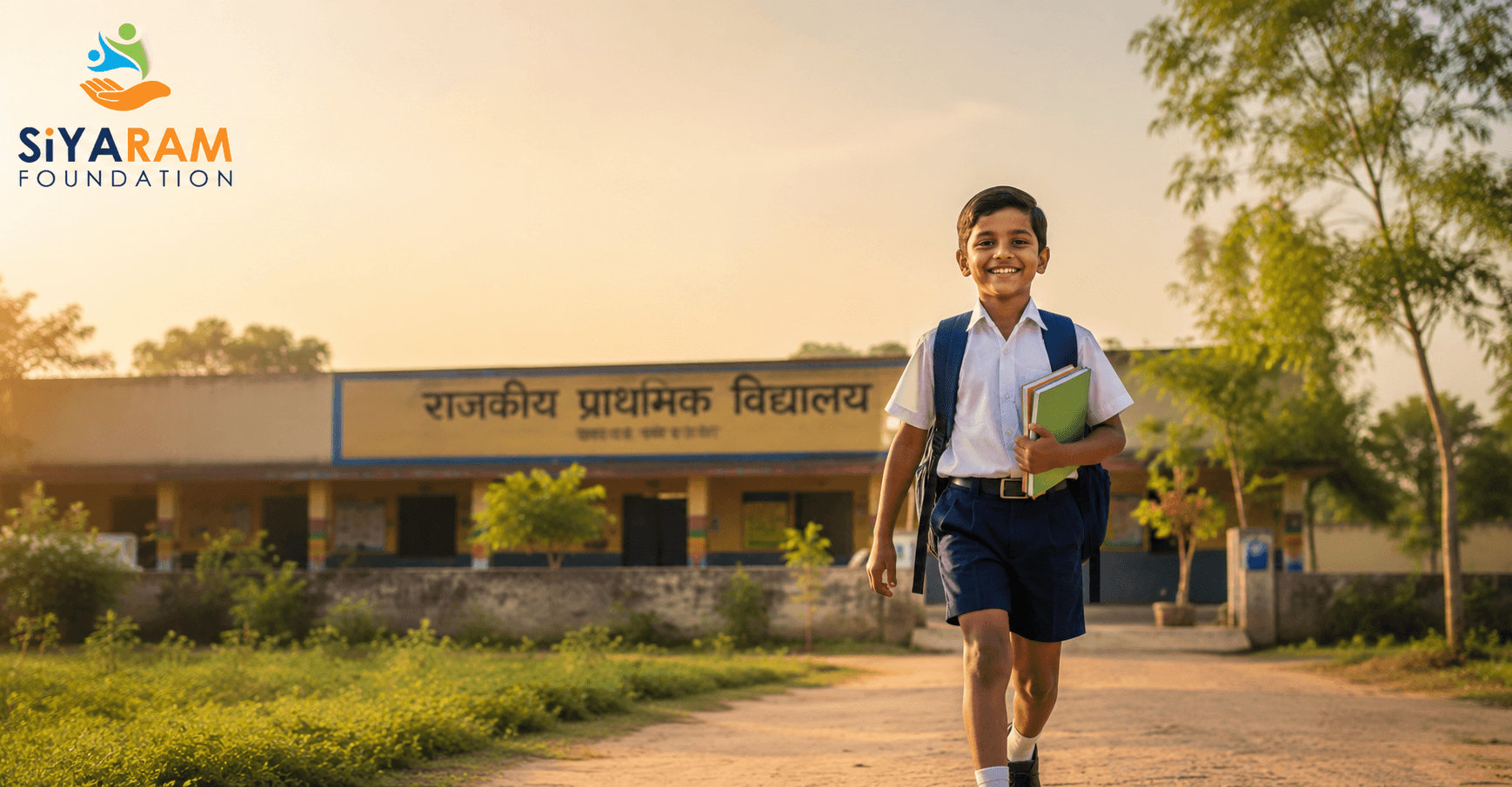
Walk through any Indian city and you'll see it within minutes a child selling balloons at a traffic signal, another washing dishes at a roadside dhaba, while somewhere nearby, kids the same age are heading to school in uniforms. That contrast is exactly why the Right to Education matters so much in this country.
At its core, it's a fairly simple idea. A child's future shouldn't depend on their parents' income or the neighbourhood they were born into. Everyone deserves a shot at learning and in India, this idea is now backed by both the Constitution and the law.
Of course, laws alone don't fix things overnight. That's usually where NGOs step in to support child education in India filling the gaps, reaching kids the system misses, and making sure this right isn't just a phrase in a legal document but something children actually experience.
What is the Right to Education?
Put simply, it means every child gets access to free, quality schooling no strings attached, no hidden costs, no "wait until you can afford it."
It rests on one belief: where you're born shouldn't decide whether you get to learn. A farmer's daughter in rural Bihar deserves the same classroom opportunity as a businessman's son in Mumbai.
India didn't leave this to chance or goodwill. It's recognised as a Fundamental Right to Education, which meant schooling stopped being something families had to beg for and became something they could claim in court if denied.
The Constitutional and Legal Backing: Article 21A
This is where a lot of blogs skip the detail and it's worth getting right, because it's the whole foundation of the law.
Education became a Fundamental Right under Article 21A of the Indian Constitution through the 86th Constitutional Amendment in 2002. Before this, access to schooling was treated more as a directive principle — a good intention, not an enforceable right.
That constitutional promise was then given real teeth through the Right of Children to Free and Compulsory Education Act, 2009 commonly called the RTE Act 2009. The Act came into force on 1 April 2010, making India one of the relatively few countries where a child can legally demand free schooling. You can read the official rules and notifications on the Ministry of Education's RTE portal.
Here's a quick snapshot of the framework:
|
Topic |
Information |
|
Constitutional Article |
Article 21A |
|
Constitutional Amendment |
86th Amendment, 2002 |
|
Governing Law |
Right of Children to Free and Compulsory Education Act, 2009 (RTE Act 2009) |
|
Effective Date |
1 April 2010 |
|
Age Group Covered |
6–14 years (Elementary Education) |
|
Reservation Provision |
25% reservation under RTE Act for economically weaker sections in private schools |
And a short timeline, if you like seeing how it came together:
|
Year |
Milestone |
|
2002 |
Article 21A added to the Constitution via the 86th Amendment |
|
2009 |
RTE Act passed by Parliament |
|
2010 |
RTE Act 2009 comes into force (1 April) |
|
Ongoing |
State governments implement RTE admission and 25% reservation rules |
Why is the Right to Education in India Important?
Ask a teacher what a classroom actually gives a child, and they'll rarely mention textbooks first. They'll talk about confidence. Curiosity. The ability to ask "why" and expect an answer.
That's really what's at stake here, and it goes well beyond literacy:
-
An educated child has a real shot at breaking out of the poverty their parents couldn't escape.
-
Schools quietly teach kids how to think, argue, and make decisions skills no one hands you at home.
-
Education levels the playing field. Rich or poor, a child who's learned to read starts life with options.
-
A country full of educated citizens tends to build stronger institutions, better healthcare, and a more functioning democracy.
-
And frankly, a child in school is a child less likely to end up in a factory, married off early, or worse.
Take education away, and it's not just knowledge a child loses. It's the whole range of choices that knowledge would have opened up.
 Key Features of the RTE Act 2009
The RTE Act turned the constitutional idea into something enforceable. Strip away the legal language and here's what it boils down to:
-
Free and compulsory education — no admission fees, no tuition charges in government schools, for children aged 6 to 14.
-
Elementary education as a right — covering Classes I to VIII, the years when foundational learning happens.
-
No discrimination — the Act applies irrespective of caste, religion, gender, or family income, and schools can't turn a child away on these grounds.
-
25% reservation under RTE Act — private, unaided schools must reserve a quarter of their entry-level seats for children from economically weaker and disadvantaged sections.
-
No-Detention Policy — no child can be held back or failed in any class up to Class 8. The idea is to keep children moving forward with their peer group instead of pushing them out of the system through repeated failure. (Some states have since introduced exams at Class 5 and 8 under later amendments, so it's worth checking your state's current rule.)
-
Neighbourhood School Norm — the government is required to ensure a primary school within 1 km of every child's home, and an upper-primary school within 3 km, so distance doesn't become an excuse to stay out of school.
-
Simplified RTE admission process — states are required to set up transparent admission procedures so families don't get stuck in bureaucratic loops.
-
Quality benchmarks — the Act also lays down minimum standards for infrastructure, pupil-teacher ratios, and trained staff, not just enrolment numbers.
The idea was to shift education rights in India from something you hoped for to something you could demand.
The Age 14 Cliff: Why RTE Coverage Stops Where It Does
Here's a gap that doesn't get talked about enough. The RTE Act legally protects children only between the ages of 6 and 14 Classes I through VIII. The moment a child turns 14 or finishes Class 8, that legal guarantee of free schooling technically ends. Secondary and higher secondary education (Classes 9 to 12, roughly ages 15–18) fall outside the Act's protection.
This isn't a small technicality it's a big part of why dropout numbers climb sharply right after elementary school. A family that managed to keep a child in school under the Act's cover suddenly has to weigh new fees, uniforms, and transport costs on their own, with no legal backstop forcing the state's hand the same way.
This is exactly the gap the National Education Policy (NEP) 2020 tries to address. NEP 2020 proposes extending the spirit of RTE well beyond its current boundaries from early childhood care and education (ages 3–6) right through to secondary school (up to age 18), moving India toward a 3-to-18 vision of schooling instead of the current 6-to-14 window. It's still a policy proposal rather than an amended law, but it signals where the country is trying to head next.
By the Numbers: Where India Actually Stands
Numbers help here, mostly because they stop the conversation from staying vague. A few figures worth knowing:
-
Literacy rate: About 80.9% of Indians aged 7 and above could read and write as of 2023–24, based on the Periodic Labour Force Survey run by the National Statistical Office up from 73% back in 2011. Real movement, just not enough to call the job finished.
-
Rural and gender gap: Rural areas still lag cities, and women still lag men. Neither is a small footnote it's basically why women's empowerment and targeted work in underserved communities continue to matter as much as school access itself.
-
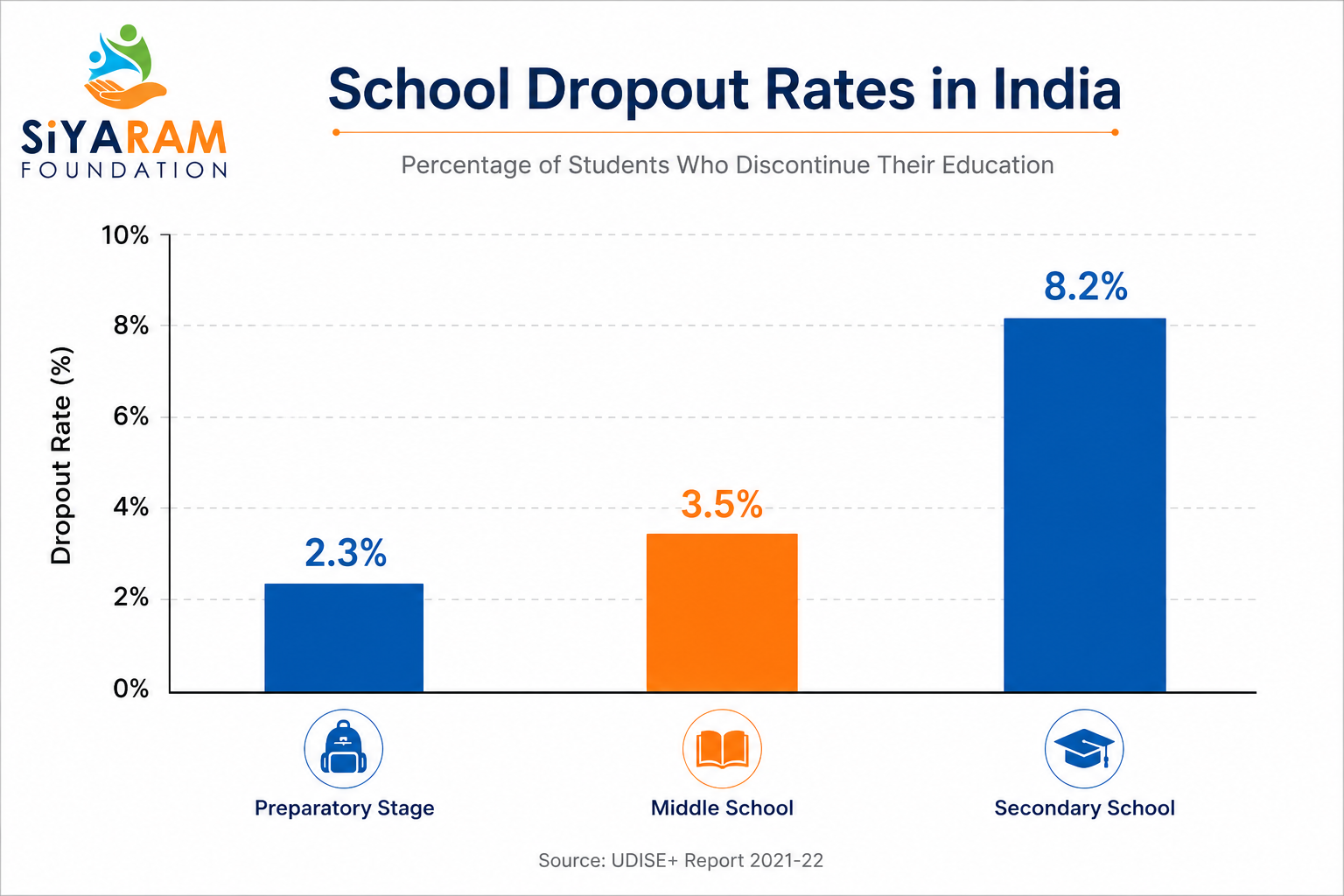
Dropout rates easing: The Ministry of Education's UDISE+ report for 2024-25 showed dropout rates improving compared to the year before — around 2.3% at the preparatory stage, 3.5% at middle school, and 8.2% by secondary school.
-
But the gap widens later: Secondary school dropout is nowhere near elementary school dropout, which confirms something a lot of teachers already know informally plenty of kids start the journey through school, far fewer finish it, and the Age 14 Cliff explained above is a big reason why.
Put both sets of numbers together and the takeaway is fairly blunt. The RTE Act has genuinely changed outcomes since it came into force. It just hasn't finished the job and the cracks widen the moment a child turns 14 and technically falls outside the Act's protection.
Challenges in Making This a Reality Across India
Here's the honest part: having a good law is only half the battle. India is enormous and unevenly developed, and that shows up in how the RTE Act plays out on the ground.
-
Poverty keeps pulling children out of classrooms and into work, because some families simply can't afford to lose an earning hand — this is exactly the barrier that education for underprivileged children in India programmes are built around.
-
Child labour remains stubbornly common in certain pockets, despite school being technically free.
-
Dropout rates climb sharply after the early grades — kids enrol, but staying enrolled is a different story.
-
Gender inequality adds another layer, with girls often pulled out for household chores, safety worries, or early marriage — one reason girl child education in India still needs dedicated attention rather than a one-size-fits-all approach.
-
Poor infrastructure — no toilets, no drinking water, overcrowded classrooms — makes many government schools genuinely hard to attend.
-
Rural gaps mean some children walk kilometres just to reach the nearest functioning school, if one exists nearby at all, despite the RTE Act's own 1km/3km neighbourhood norm.
None of this means the law failed. It just means legislation can open a door but someone still has to walk children through it, again and again, family by family.
How NGOs Help Turn This Right Into Reality
This is exactly where grassroots organisations earn their keep. Policy sets the destination; NGOs often do the walking.
In practice, that support tends to look like:
-
Covering school fees and admission costs for families who'd otherwise have to choose between rent and a report card.
-
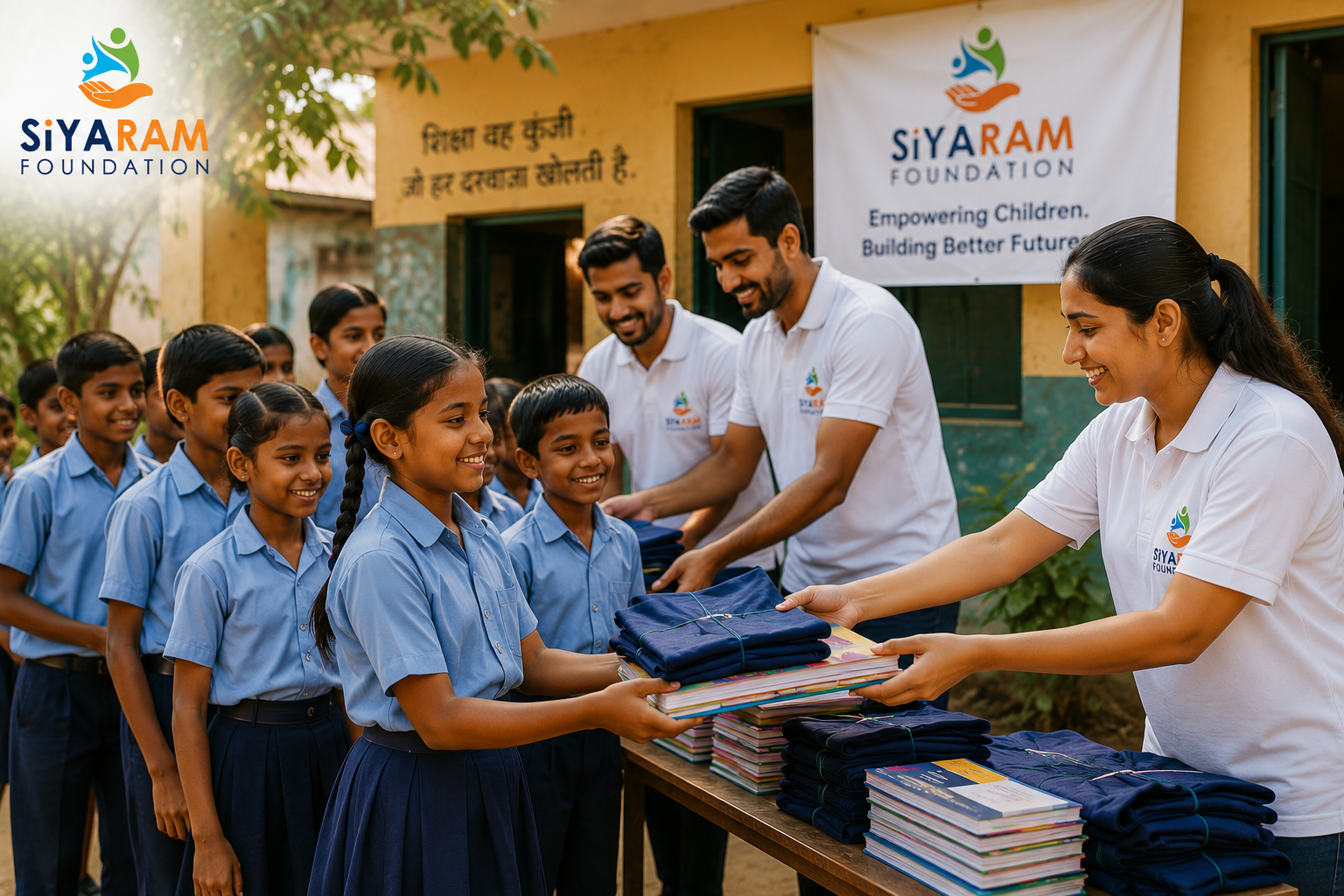
Handing out uniforms, books, and school bags, because for many parents, that "small" expense is the actual barrier.
-
Sitting with parents in their homes or communities, explaining why school matters more than an extra day's wage.
-
Funding scholarships for students sharp enough to go further, if only money weren't in the way.
-
Introducing children to computers and basic digital tools, especially where classrooms have never seen a screen.
-
Running dedicated efforts to keep girls in school, since they tend to face the steepest odds of dropping out.
Based on Siyaram Foundation's work with underserved communities, many children still face barriers such as poverty, lack of school supplies, and limited access to nearby schools — even years after the RTE Act came into force. That gap between what the law promises and what a family can actually access is precisely where our work sits.
At Siyaram Foundation, this isn't abstract it's uniforms handed over before the school term starts, a scholarship that lets a bright student stay in class instead of dropping out, a parent convinced to send their daughter back to school after a difficult conversation. Nothing dramatic. Just the slow, unglamorous work of keeping children where they belong.
How You Can Help
You don't need to change laws or run a school to make a difference here. Most of the real change happens through small, repeated actions the same way any NGO in India grows, one supporter at a time:
🎓 Support a Child's Right to Education Today
-
Donate Now — even a modest amount can cover one child's books or uniform for a year.
-
Volunteer With Us — teach a weekend class, mentor a student, or help run an awareness drive.
-
Sponsor a Child's Education — commit to one child's schooling for the long haul, not just a one-time gift.
-
Talk about it — mention the issue to friends and family. Awareness spreads slower than we'd like, but it does spread.
Support Siyaram Foundation Now
None of these feel huge on their own. Together, they're often the difference between a child staying in school and dropping out.
Conclusion
The Right to Education isn't just legal text it's a promise, rooted in Article 21A and carried forward by the RTE Act 2009, that a child's postcode or parents' income shouldn't decide their future. The Act gave that promise legal weight, but turning it into everyday reality is still unfinished work, and it needs more than government offices to get there.
Organisations like Siyaram Foundation keep showing up for that unfinished part one uniform, one scholarship, one family conversation at a time. If this matters to you too, there's a place for you in it. Support Siyaram Foundation through a donation, a sponsorship, or simply by telling someone else about it. Every child who gets to stay in school because of it is a small, real win.
Frequently Asked Questions
1. What is the Right to Education?
In short, it's a child's legal claim to free schooling between the ages of 6 and 14. No family should have to skip school because of money, caste, gender, or which village they live in and in India, that's no longer just a nice sentiment, it's written into law.
2. What is the Right to Education Act?
This is the RTE Act 2009 full name, the Right of Children to Free and Compulsory Education Act. Parliament passed it in 2009, but it only became active on 1 April 2010, and that's the date most government records treat as the real starting point.
3. What is Article 21A of the Constitution?
Article 21A is what makes education a Fundamental Right in India, not just a government scheme. It was added to the Constitution in 2002 through the 86th Amendment, and the RTE Act was drafted a few years later to actually put that right into practice.
4. Who is eligible under the Right to Education Act?
Every child aged 6 to 14 full stop. Caste, religion, gender, or how much the family earns doesn't change that. In school terms, this covers Class I right through Class VIII.
5. What is the 25% reservation under the RTE Act?
Private schools that don't receive government aid still have to keep a quarter of their entry-level seats open for children from poorer or disadvantaged backgrounds. It's one of the more practical parts of the Act it puts children from very different economic worlds in the same classroom.
6. What is the No-Detention Policy under RTE?
It means no child can be failed or held back in any class from Class 1 to Class 8. The goal was to stop children from dropping out simply because they failed an exam. Some states have since added periodic exams at Class 5 and 8, so it's worth checking local rules.
7. Does RTE cover secondary or high school education?
No the RTE Act's legal guarantee only covers ages 6 to 14 (Classes 1–8). Secondary school (Classes 9–12) isn't legally covered yet, though NEP 2020 has proposed extending this protection up to age 18.
8. Why is the Right to Education important?
Because without it, a child's starting point in life is decided almost entirely by their parents' bank balance. Education pushes back against that it cuts down child labour and early marriage, and over time, it builds a society that's simply more capable of solving its own problems.
9. How do NGOs support children's education in India?
Mostly through the unglamorous stuff paying admission fees, handing out books and uniforms, running scholarships, and sitting with parents to explain why school is worth it. Digital learning support has become part of this too, especially in areas that never had computers to begin with.
10. What challenges affect children's access to education?
Poverty tops the list, closely followed by child labour and dropout rates that spike once kids get a bit older. Add gender bias, patchy school infrastructure, and long distances in rural areas, and you get a fairly accurate picture of why the RTE Act alone hasn't solved everything.
11. How can I contribute to a child's education through an NGO?
Donate if you can, volunteer your time if you can't, or sponsor one child's schooling if you want something more direct. Even just talking about it with people around you does more than most people realise the gap between what the law promises and what a child actually gets often comes down to awareness as much as money.